

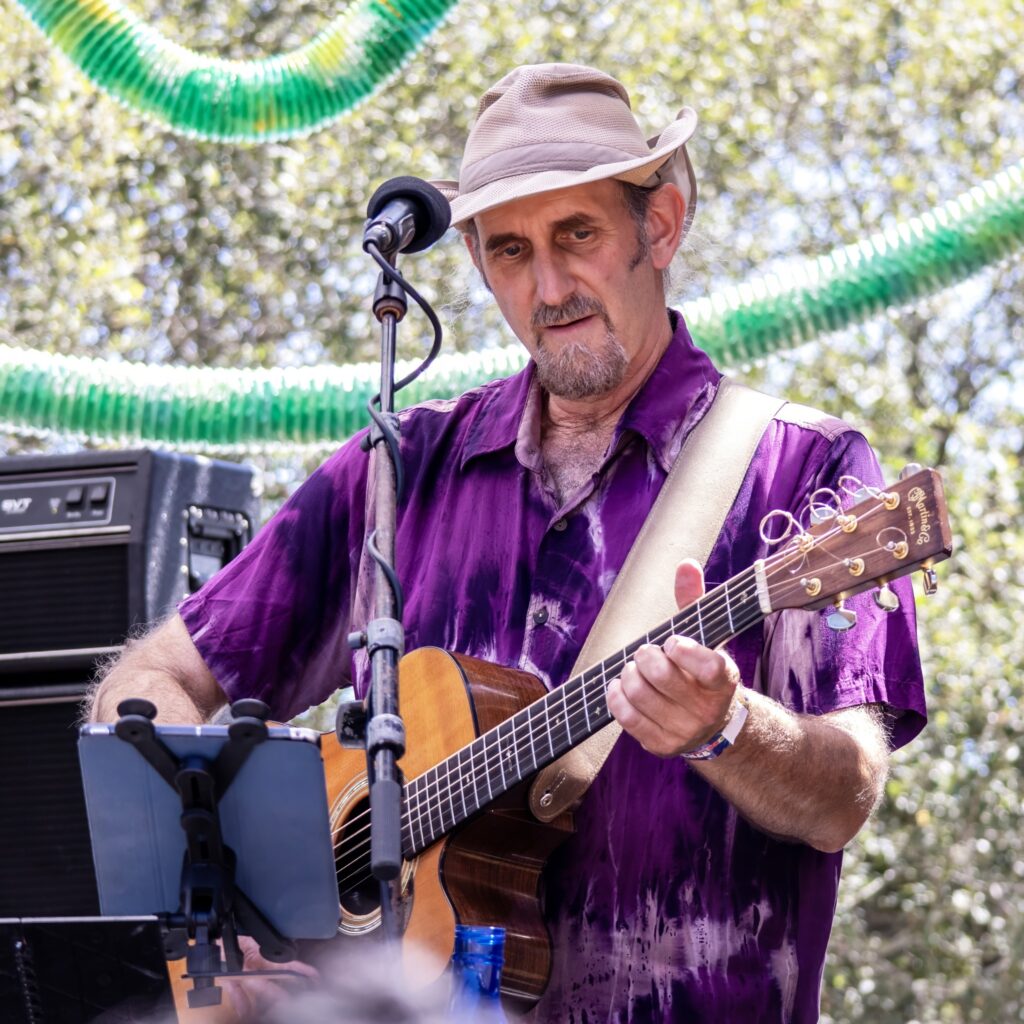
For Stuart Markus, music has always lived at the intersection of performance and connection; it’s where the craft of playing meets the joy of reaching people in a way words alone can’t. Whether he is playing a familiar Sinatra tune in a senior center or softly strumming the song “You Are My Sunshine” for a resident, Stuart uses music as a bridge, one that reaches across mental states, lived experiences, and generations.
A Lifelong Relationship with Music
Stuart’s journey as a musician began long before he ever stepped into a nursing home or assisted living facility. He started piano lessons at 6, guitar at 8, and has been singing since before he can remember. As a college student at the University of Pennsylvania, he immersed himself in music in every way possible. He participated in the marching band, wind ensemble, choir, and multiple a cappella groups. By his senior year, he was even directing one of these ensembles.
“I always loved music and dreamed about doing it for a living,” Stuart shared. However, growing up in a family whose involvement with the performing arts was primarily in the audience, he had little guidance on how to turn his dream into a career. After graduating, he followed a more traditional path, entering the advertising field with help from his uncle. While selling advertising for local newspapers and radio, he was able to express some of his creativity through this job by designing and writing ads.
After nearly a decade in advertising, Stuart transitioned into journalism, becoming a writer and editor. Though he found success in this field, music never left his life. It remained a constant presence, as something he loved deeply but did not yet see as a full-time profession.
Everything changed about eleven years after college when Stuart met a fellow songwriter at an open mic night. She made much of her living performing in nursing homes, a career path he had never considered. “I didn’t even know [nursing home performances as a career] was a thing,” he recalled. Through her, he learned about agencies that booked musicians for senior communities and began performing himself.
For the first five years of his career, he balanced music with his day job. But after being laid off during the post-9/11 recession, Stuart found himself at a crossroads. Deciding to go all-in on a career in music, after a year of freelancing and building his performance career, he became a full-time musician!
Today, Stuart performs in senior centers and nursing homes 1-3 times a day, but also gigs at restaurants, private events, and country clubs, and plays folk stages and municipal parks with his folk-rock trio Gathering Time. Performing for older adults has become the foundation of his career, his new “day job,” and a source of deep personal fulfillment.
Understanding His Audience
When Stuart first began performing for older adults, much of his set list centered on music from the 1920s and 1930s, such as songs like “Let Me Call You Sweetheart” and “Sidewalks of New York.” As generations have changed, so has his setlist.
“Now, Frank Sinatra is about the oldest music,” he explained. Today, he often plays music by Elvis Presley, The Beatles, and The Drifters, along with other popular hits from the 1960s and 1970s.
But beyond music genre, Stuart pays close attention to the residents he plays for. Some audiences sing along and clap enthusiastically. Others, especially those living with dementia or Alzheimer’s disease, may not respond outwardly at all.
That does not mean the music isn’t reaching them.
“You look for little signs,” Stuart said. A tapping finger. A slight head bob. Silent mouthing of lyrics. Even a small gesture can signal that a connection is forming.
“It’s how you know you’re getting in,” he shared. “You’re reaching them somehow.”
Significant Moments
Some of Stuart’s most powerful memories come from early in his career. One experience, in particular, continues to shape his understanding of music’s power.
While performing a “strolling” program at a nursing home, walking through hallways and small lounges, he encountered a woman sitting silently, staring at the floor. She appeared completely unresponsive. After greeting her without success, he gently began singing “You Are My Sunshine.”
By the second chorus, her eyes began to blink. Soon, she lifted her head. By the third repetition, she was singing along.
“After I finished, she started talking,” Stuart recalled. “She said, ‘Oh, how lovely.’”
In just a few minutes, music had brought her back into the present.
You just hope to keep that flickering flame of life alive.
Stuart Markus
In another experience at a psychiatric center, a young man requested “(Sittin’ On) The Dock of the Bay.” After Stuart performed it, the man thanked him. While this may have seemed like an ordinary encounter at first, a staff member later explained that those were the first words the young man had spoken in months.
Sometimes, the most powerful moments happen when no one is expecting them. Once, while playing the song “Route 66,” Stuart noticed an elderly man who had been seemingly asleep suddenly lift his head and sing one word: “Sixty-six!”
“Sometimes things are getting in, and you don’t even realize it,” he said.
These moments reinforce Stuart’s belief that music reaches parts of the human mind and spirit in ways that few other things can.
Music and Healing
Stuart views music as a powerful tool for emotional and cognitive well-being. He explains that music stimulates many areas of the brain at once: language, rhythm, melody, and memory.
“Songs can take us back to faraway places and times,” he said. “You hear something you haven’t heard in years, and suddenly you remember where you were, who you were with, what you were feeling.”
For seniors, especially those facing depression, isolation, or cognitive decline, this stimulation can be significant, if temporary. Stuart has seen residents’ moods lift after just one song. Some have told him that his music “brightened their day.”
Depression is common in long-term care settings, where residents may struggle with the loss of their spouses, friends, and family, physical decline, and feelings of obsolescence as they age. Music, Stuart believes, helps counter these experiences.
So much of staying alive is having a reason to want to stay alive.
Stuart Markus
“So much of staying alive is having a reason to want to stay alive,” he said.
Through his performances, he aims to offer joy, validation, and emotional connection, continually reminding residents that their lives and memories still matter.
Growing and Performing
Stuart shares that working with older adults has also shaped him as a musician. He has developed a deep appreciation for the American Songbook, jazz standards, and traditional folk music. He views songs as “historical documents”: windows into the culture, language, and values of past generations.
Stuart often researches the origins of songs, learning about their writers, meanings, and social contexts. This curiosity has strengthened both his musicianship and his understanding of history.
Technically, performing solo has pushed him to grow. He works to recreate full musical arrangements on a single guitar, incorporating bass lines, melodies, and harmonies. This challenge has refined his musical skill and expanded his creativity.
Perhaps most importantly, Stuart has learned what it means to truly be a performer. A performer is not just someone who plays in the background but someone who continually seeks to improve their craft, engages the audience, and emphasizes connection.
Advice for Future Senior Living Community Musicians
For those interested in working with senior communities, Stuart emphasizes the importance of listening, both to music and to people.
Stuartencourages aspiring performers to explore songs from the 1940s through the 1970s, talk with older relatives, and learn what music shaped their lives. He believes many older songs remain so impactful because of their intricate melodies and thoughtful compositions.
He also highlights the importance of initiative. Whether through agencies or independent outreach, connecting with senior communities requires persistence and communication skills.
“Mostly, listen to as much music as you can,” he advises. “And don’t limit yourself to what you like right now.”
Keeping That Flame Alive
As Stuart reflects on his work, he speaks candidly about witnessing Alzheimer’s disease in both his audiences and his own family. Watching once-vibrant individuals lose parts of themselves is painful. Yet through music, he sees glimpses of who they still are, often through small gestures, like bopping along to the song, simply lifting their head, or offering a smile.
“You just hope to keep that flickering flame of life alive,” he said.
Through every song he plays, Stuart Markus does exactly that. He preserves memories, lifts spirits, and reminds older adults that they are seen, heard, and valued. In doing so, he transforms simple melodies into moments of healing and turns every performance into an act of compassion.