

Deep Dive Into Slime Molds
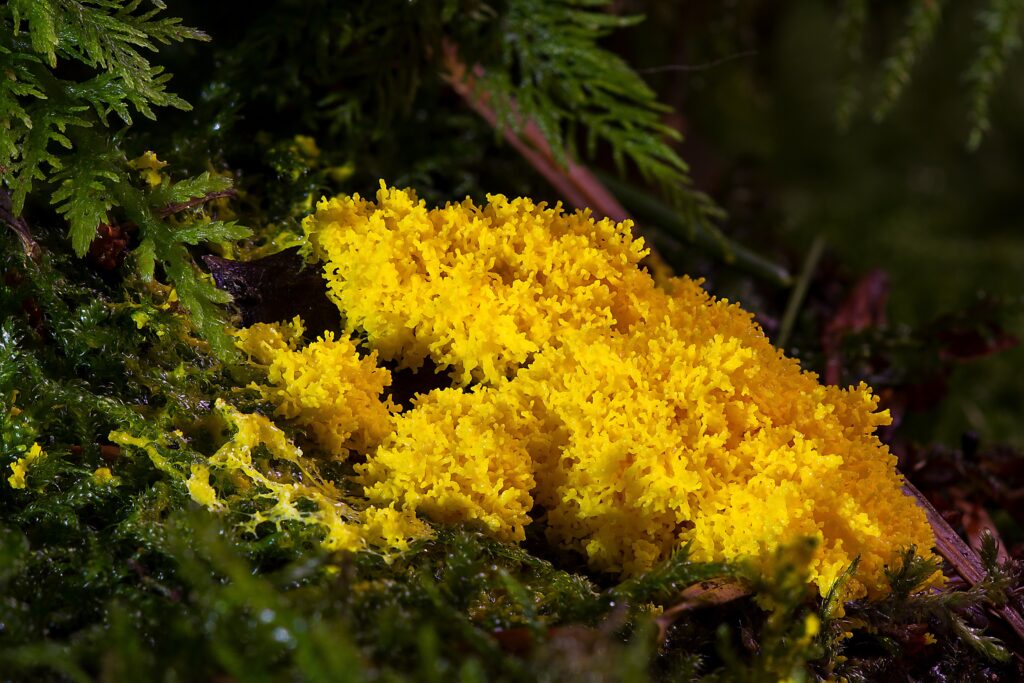
Slime molds have been of great interest to memory researchers. Taxonomically speaking, these organisms are single-celled eukaryotes from the Protista kingdom. This means they do not have a brain, nor are they a fungus, animal, or plant. Instead, they are classified as “amoeba-like,” where their main function is to decompose microbes, bacteria, and decaying matter by engulfing and destroying them through phagocytosis; this makes them saprotrophs. Protists are quite diverse, as they are part of the “other” category for eukaryotes. In other words, when scientists encounter an organism that is neither a fungus, animal, or plant but is still a eukaryote, it is labeled as a protist.
Despite not having a brain or a nervous system, slime molds, particularly those from the Physarum genus and polycephalum species, are able to remember a great amount of information. P. polycephalum is known as the “many-headed” slime mold and is multinucleated, making it large in size compared to other protists. In fact, they can grow up to many feet and typically develop in damp environments, such as mulch, woods, or logs. Apart from containing multiple nuclei, slime molds can fuse with each other, often growing even larger! Their large size is what makes them so appealing to research, as they can cut up the slime molds many times and have them fuse back together into one organism. When slime molds grow and decompose organic matter, they are in the vegetative state of their life cycle; for that reason, they are called plasmodial (acellular) slime molds.
Plasmodial slime molds contain many nuclei because they go through continuous cell division and do not perform cytokinesis (i.e., their cytoplasm does not divide to form new daughter cells). As a result of their multiple nuclei, they are able to solve problems and learn new things at a fast rate. For that reason, plasmodial slime molds have been of interest for many other disciplines other than memory research, including nutrition, decision-making, and regenerative medicine.
P. polycephalum Memory Tests
In 2000, Japanese researcher Toshiyuki Nakagaki investigated the relationship between plasmodial slime molds and memory through a maze test. There, he scattered the plasmodial slime molds in a maze and only left food particles at the beginning and end of the apparatus. The aim was to test how long it would take the plasmodial slime molds to figure out how to escape the maze if they could at all. To his surprise, the plasmodial slime molds began to grow and fuse with one another across the maze. Ultimately, the plasmodial slime molds were able to find the fastest route to escape the maze, even more efficiently than engineers and Harvard graduate students! Here is a video demonstration of the plasmodial slime molds being able to solve the maze in such a fast time.
Plasmodial slime molds do this by releasing a thick layer of extracellular slime (i.e., cytoplasm) where they travel. This allows the plasmodial slime mold to not reenter locations it previously was in; this process is called shuttle streaming. A finding like this suggests that P. polycephalum have some sort of externalized spatial memory, as they are able to recognize places they have and have not traveled to yet and avoid the former.
Furthermore, when plasmodial slime molds sense they are approaching something they are attracted to, like a food source, they use chemotaxis. Chemotaxis refers to the feedback loop process organisms use to move towards a substance they like or away from a chemical they don’t. Once organisms get used to the stimuli due to constant exposure, their response diminishes over time; this process is called “habituation.” Chemotaxis refers to the feedback loop process organisms use to move towards a substance they like or away from something they don’t; this process is called “habituation.” When plasmodial slime molds are near something they like, they thicken and widen their complex tubal network by pulsating more cytoplasm to that area; this makes the tubes softer so it is easier for food to pass through and helps them move to the spot they want to traverse to. If they find something dangerous that they are repelled towards (e.g., salt), the cytoplasm starts to move out of these tubes, making them get thinner, shrink, and eventually die off. Once habituated, P. polycephalum are able to remember this rhythmic pulsing even if they are experiencing prolonged durations of dormancy, which is a period of time known as “sclerotia.”
Responses to Neighboring Cells
Apart from this, plasmodial slime molds are able to send signals to other plasmodial slime molds to avoid the repellent, even when the latter have not yet interacted with the bitter chemical. Scientists predict they can transfer these acquired memories by mixing their cytoplasm, which allows plasmodial slime molds to signal when a repellent is nearby. In other words, when a plasmodial slime mold is habituated to its environment and has adjusted its response to the stimuli (i.e., either by interacting or avoiding the substance), it can transmit this reaction to another plasmodial slime mold that has not been habituated. This suggests that plasmodial slime molds also have an internal process that helps with their locomotion, in addition to their habitual characteristics that they get from their external environment.
Aside from this form of communication, plasmodial slime molds are able to differentiate paths traveled by stressed or starved plasmodial slime molds from well-fed ones. They will typically avoid the former and prefer to approach the latter. Plasmodial slime molds also know how to identify the cytoplasm of other plasmodial slime molds or from other slime mold species and can choose to explore elsewhere. Such a process allows them to save time by not traveling the same route another slime mold did, especially if they cannot sense any food source is nearby. All these examples further showcase how smart plasmodial slime molds are and their capacity for learning.
Navigating Complex Environments
To test how plasmodial slime molds navigate complex environments, behavioral biologist Chris Reid and colleagues placed the P. polycephalum in a petri dish that had a U-shaped barrier, which blocked the plasmodial slime molds’ access to food. Since the barrier was coated in dry acetate, the plasmodial slime molds could not go over it; instead, they would have to contort their bodies to fit the complex shape of the barrier to escape. Despite this challenge, 23 of the 24 plasmodial slime molds were able to successfully complete the task by using their extracellular slime.
However, when Reid covered the rest of the maze with extracellular slime, only eight of the 24 plasmodial slime molds were able to find the food. This is because the plasmodial slime molds were now no longer able to differentiate between the regions they previously traveled to, as the whole maze was covered in this fluid. Even though fewer plasmodial slime molds were able to complete the latter objective, it still shows how intelligent they are that they are able to recognize where they did and did not travel to and the significance of their cytoplasm to help with this process.
To further depict the intelligence of these unicellular organisms, researchers recreated Tokyo’s railway network and the highways of Canada, the UK, and Spain in miniature versions. In this model, scientists placed small bits of oat flakes to resemble the big cities and urban areas in these regions. When the plasmodial slime molds were introduced, they immediately engulfed all the oat flakes by extending their pseudopods (i.e., foot-like projections). Doing this allowed them to find the food and escape the U-shaped apparatus in the shortest path possible.
Again, the researchers noticed how the plasmodial slime molds left behind their cytoplasm to connect themselves with each other, leaving behind the silhouette of a well-designed network between them and the food. The trail was so astounding that it actually mirrored the railway and highway networks of the aforementioned locations! When plasmodial slime molds release their extracellular slime, it allows them to anticipate future events and precisely predict where they should go to avoid any dangers and dead ends based on their past experiences. Researchers concluded that plasmodial slime molds use episodic memory, which is when the organism stores and encodes information in response to prior events.
Memory Research Significance
Currently, we still do not understand how plasmodial slime molds are able to possess all these qualities, especially as our previous consensus was that these actions needed to be performed with a brain. This all goes to show that a brain is not always needed to retain information and how there are other physiological pathways that can enable this process.
Such a sentiment, however, is still considered controversial among different researchers in the scientific community, especially in neuroscience, as it challenges the traditional perspective on memory and intelligence. Some scientists are still under the impression that simply structured organisms, like plasmodial slime molds, should not have the capabilities to retain memories and that this function is only expressed in the nervous system. They are also skeptical of plasmodial slime mold research, in general, as it may devalue the importance of the brain. Therefore, for them, plasmodial slime mold research is considered futile.
For that reason, it is important for the public and scientific community to research plasmodial slime molds to understand their true potential, especially as there is still so much we do not know about them. Other than filling in the gaps of knowledge we currently have about memory, this research will also benefit older adults, especially those living with cognitive decline. At the same time, we should not undermine the importance of the brain and how it helps us with our own decision-making and memory recollection. Simply put, two things can be true at the same time, which is that both the brain and plasmodial slime molds are crucial for our understanding of memory.
Sources:
- Physarum polycephalum—a new take on a classic model system | ADS
- Slime Mold 101: Meet the Genius Without a Brain | The Biomimicry Institute
- Slime mold uses an externalized spatial “memory” to navigate in complex environments | PMC
- Memory inception and preservation in slime moulds: the quest for a common mechanism | Philosophical Transactions of the Royal Society B
- How Brainless Slime Molds Redefine Intelligence [Video] | Scientific American
- Brainless but Multi-Headed: Decision Making by the Acellular Slime Mould Physarum polycephalum | ScienceDirect
- Slime Molds Remember — but Do They Learn? | Quanta Magazine
- Thoughts from the forest floor: a review of cognition in the slime mould Physarum polycephalum | PMC