

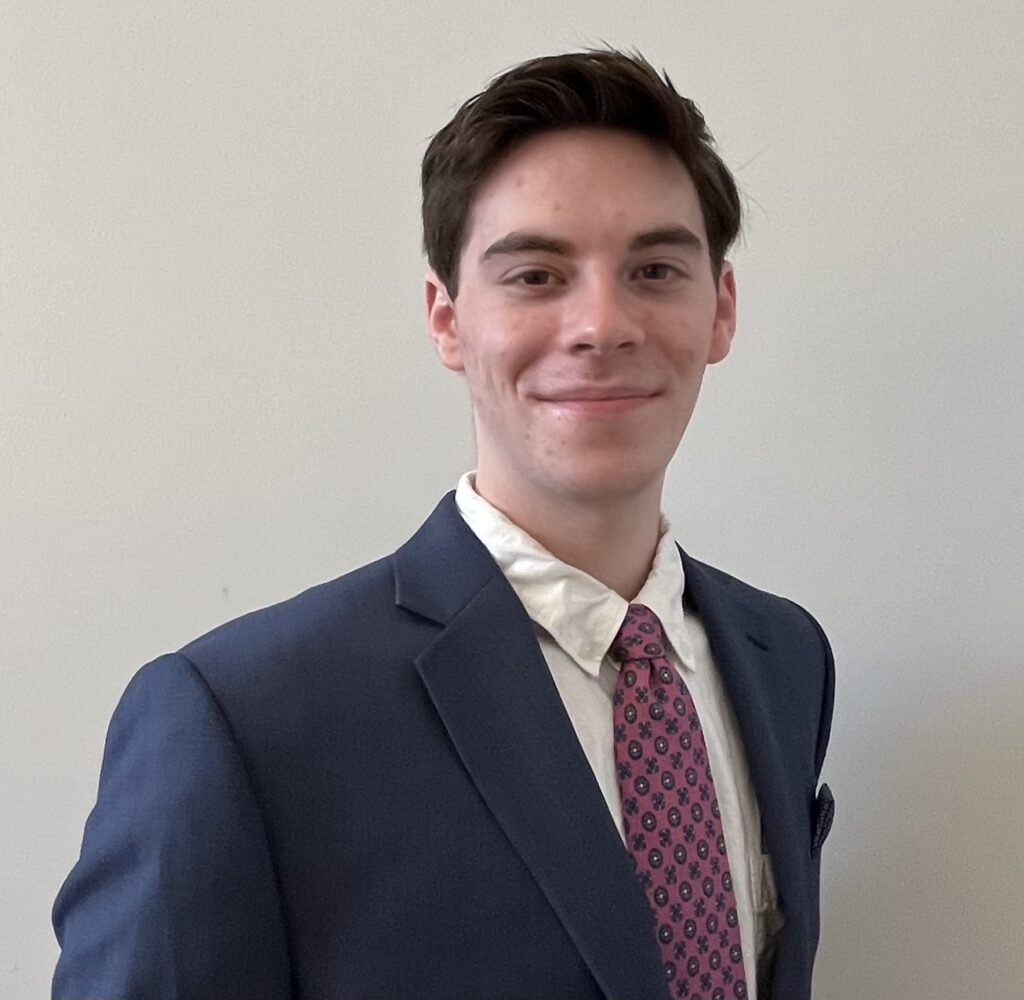
When most people think of starting a nonprofit, they picture years of planning, business degrees, and strategic roadmaps. But for Aaron Lefkowitz, the founder of Conversations to Remember, the journey began with something much simpler: a grandson’s love for his grandmother and a young student’s curiosity about the human mind.
Early Interests
Originally from New Jersey, Aaron is now a mechanical engineering student at Johns Hopkins University in Baltimore. He grew up fascinated by the brain and the science behind human behavior. His interest became deeply personal when his grandmother was diagnosed with dementia. “It was my first time really seeing what dementia looks like,” he shared. “Seeing how it affected her, and seeing the environment of the assisted living community, opened my eyes to how much loneliness many seniors experience.”
Beginnings of Conversations to Remember
Aaron began volunteering at a local assisted living facility, spending Friday afternoons playing bingo, chatting, and socializing with residents. But then the COVID-19 pandemic hit, forcing senior communities to close their doors to outsiders. Unable to visit in person, Aaron reached out to the community where he’d been volunteering and suggested trying something new: weekly virtual one-on-one calls with seniors. The first call was so impactful that he brought in friends to start additional visits. Before long, the demand outgrew what the senior community could accommodate, and an idea that began as a small act of kindness quickly grew into something much larger.
As Aaron describes it, “It was one of the silver linings of COVID. We all learned how meaningful virtual conversations could be.”
After witnessing the positive impact of virtual visits, Aaron and his sister, Ilana, approached their parents with the idea of building something bigger. United by a shared commitment to easing isolation among seniors, the Lefkowitz family combined their talents to launch Conversations to Remember. What began as a local act of compassion, soon evolved into a national movement, connecting young adults with seniors across the country, through the simple, yet powerful, act of conversation.
Growing the Organization
Aaron says the evolution of the nonprofit taught him when to take the lead and when to seek support. “I started this when I was a high school student,” he explained. “As it grew, I had to recognize the limits of what I could do alone. I didn’t have a business background, but my parents did. Their experience let us dream bigger.”
As the organization grew, Aaron stayed deeply involved, continuing weekly calls for years, leading volunteer training, and supporting strategic planning. Now in his final year of college, he looks forward to expanding his involvement after graduation. “This semester is actually my first one not doing weekly calls,” he said. “I hope to return to them soon, and eventually join the board.”
Of all the moments Aaron has experienced with Conversations to Remember, one stands out: his very first senior video call.
“I spoke with her for a couple of years,” he recalled. “She called us her family. She would introduce me and the other student as ‘her boys’ when we visited over video.”
The bond the three of them built, in a time when the world felt more isolated than ever, confirmed to Aaron that virtual connections could be just as real and transformative as in-person ones.
Dual Benefits
Conversations to Remember was founded to fight loneliness among seniors, but Aaron believes the program profoundly shapes students as well.
For seniors, the benefit is clear: consistent companionship, emotional support, and meaningful intergenerational connection. Aaron emphasized that many seniors who most need support – those who are unable to leave their room or have in-person visits for a variety of reasons – are the least likely to be found in public community spaces. “We’re reaching people who otherwise might never be reached,” he said.
But students grow too. Through weekly calls, they learn life skills. Aaron highlights that reliability, professionalism, communication, and empathy are skill sets that students further develop by committing to these weekly calls. “Seniors are a marginalized group,” Aaron said. “They shouldn’t be forgotten. They have struggles and stories just like anyone else.”
When asked what message he would send to every young person, Aaron didn’t hesitate:
“It’s easier than you think, and a lot more meaningful than you imagine. Even if you never volunteer with us, just call your grandparents. That small action can have a much bigger impact than you realize.”
The Future
Today, Conversations to Remember connects students and seniors all across the country. But Aaron believes this is just the beginning.
“We’re reaching many people, but there are so many more seniors we could help,” he said. “I want the organization to continue growing: more students, more seniors, more connections.”
What started as one teenager’s attempt to stay connected to seniors during a global pandemic has grown into a nationwide movement touching thousands of lives. Conversations to Remember stands as a testament to the power of simple, human conversation, and to Aaron’s belief that no senior should ever feel forgotten.
Through his leadership, compassion, and vision, Aaron continues to show that meaningful change doesn’t always begin with grand plans, and sometimes, it begins with a single conversation.